One ordinary tap. The system behind it.
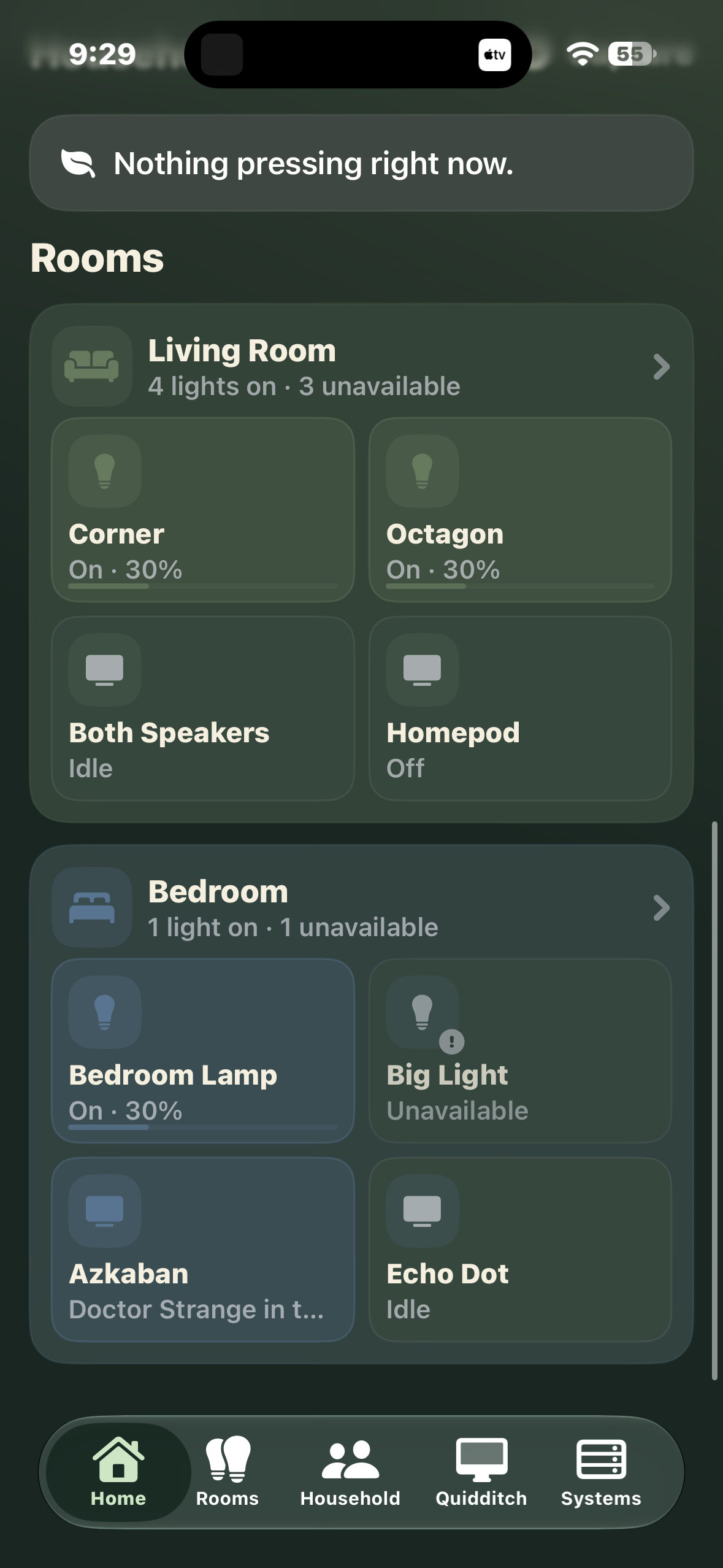 CornerOff
The Burrow asks Home Assistant to turn on a light.
First it crosses the house, over Wi-Fi to an access point.
The wired network carries it up to Dumbledore, the core switch. Most of the network sits this one out.
From the core, a cable runs to the machine room.
It lands on pollyjuice, a Raspberry Pi running Home Assistant. Home Assistant switches the light.
The machine room is three layers: hardware, then virtual machines and containers, then the services I actually use.
pmox hosts four containers and four sleeping VMs. pollyjuice runs its services directly. Gringotts hosts a monitoring VM.
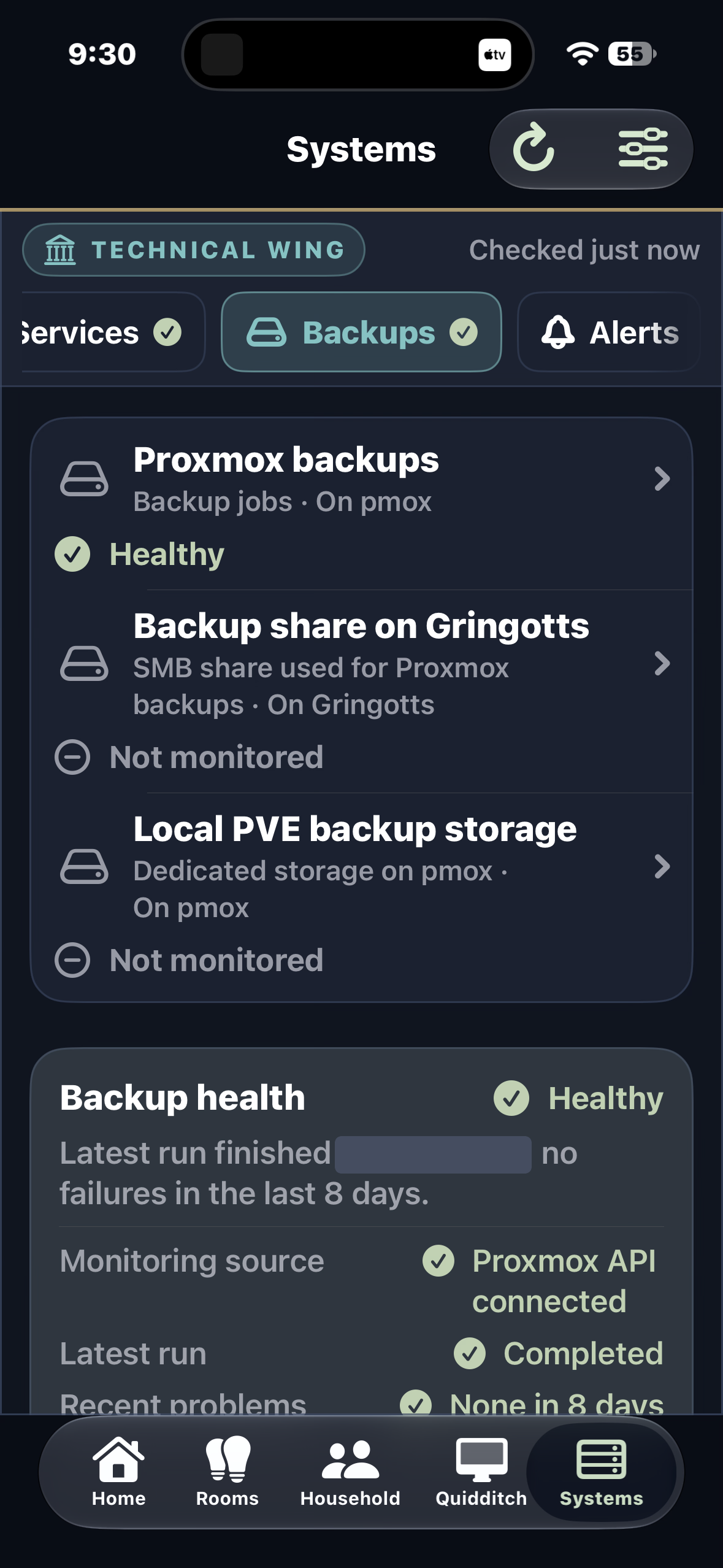
Proxmox backs up twice: to a disk in pmox and to Gringotts. A backup only counts if it restores, so on Oct 11 I restored backups into temporary guests.
The restores completed. I did not boot the restored VMs, so this shows the data comes back, not that a machine or its apps would start.
The Burrow shows backup health from the run history.
The answer retraces the same path, back to the phone.
The light is on. Corner now reads On · 30%.
- 8network devices
- 3machines
- 4containers running
- 4networks
- 2DNS resolvers
The houses switches and Wi-Fi
The machine room servers and what runs on them
cabling checked, Oct 2026 seen running, early Nov 2026 from my notes An illustrative map: no addresses, no port numbers.
One ordinary tap. The system behind it.
- The Burrow asks Home Assistant to turn on a light.
- First it crosses the house, over Wi-Fi to an access point.
- The wired network carries it up to Dumbledore, the core switch. Most of the network sits this one out.
- From the core, a cable runs to the machine room.
- It lands on pollyjuice, a Raspberry Pi running Home Assistant. Home Assistant switches the light.
- The machine room is three layers: hardware, then virtual machines and containers, then the services I actually use.
- pmox hosts four containers and four sleeping VMs. pollyjuice runs its services directly. Gringotts hosts a monitoring VM.
- Proxmox backs up twice: to a disk in pmox and to Gringotts. A backup only counts if it restores, so on Oct 11 I restored backups into temporary guests.
- The restores completed. I did not boot the restored VMs, so this shows the data comes back, not that a machine or its apps would start.
- The Burrow shows backup health from the run history.
- The answer retraces the same path, back to the phone.
- The light is on. Corner now reads On · 30%.
It started with a switch and an access point.
The homelab began as an 8-port UniFi PoE switch and a single wireless access point. That was the whole network.
It grew gradually into what you just explored: more switches and access points, a gateway, servers, virtual machines, and the services and apps that run on them. None of it was planned in one go. It is what happens when you keep trying things, fixing what breaks and improving it again.
I still run it, troubleshoot it and change it. It is the network my own house uses every day.
Built over time. Still evolving.
A few of the recent improvements, from the last few weeks of documented work. They show how I work on it, not the whole history. Drag through them.
A documentation baseline
Before changing anything, I started a repository to document the network and what runs on it, keeping track of what I knew for certain and what I still had to check. The first entries recorded the switch layout and fixed a stale DNS setting on my Mac.
Reconciling documentation with a live audit
A full audit of what was actually running. Services, storage and dependencies were mapped, and the places where my notes and reality disagreed were written down instead of papered over.
Backups, tested
Proxmox guests got automated backups to separate storage. Each backup was restored to a temporary guest to prove it works, not just that it exists.
A second DNS resolver
A second Pi-hole, in a container on Proxmox, was checked against the primary before any real traffic used it. The plan and the checks were written up in a checkpoint document.
One segment first
A pilot on a single Mac, then the main Wi-Fi network moved to two resolvers, each step checked, with a way back.
The other segments
The smart-home and camera networks followed after their own validation.
Rollout closed
All four segments on two resolvers, written up with what changed and what was verified, and committed to the repository.
Still a running record
Work after the rollout, including refinements to the Marauders pages, was added to the repository. It is a log of ongoing work, not a finished project.
Selected recent work. Dates are from the infrastructure repository's commits and checkpoint documents.
How I built it
The hardware and platforms: UniFi and Cisco networking, a Proxmox host, a Raspberry Pi and a Mac mini, and open-source services like Pi-hole, Home Assistant, Plex, Uptime Kuma and Graylog.
The network layout and segmentation, where each service lives, the two-resolver DNS design, the backup arrangement, the integrations between them, and how changes get rolled out.
The Burrow app, the custom theme and status script behind Marauders (and its experimental Castle), and a small Home Assistant component, Burrow Beacon.
An infrastructure repository with an audit trail, backups that have been test-restored, written checkpoints for risky changes, and ongoing troubleshooting and maintenance.
The Great Hall is built on the open-source Homepage dashboard. Licenses and credits.